10 epochs used to mean 20 days. Now it’s 12.
LST Radar Research · · updated 2026-10-19
Ten epochs covered 20 days in July and 12 days in October. Our readings show why a consistent time horizon matters, and why we use roughly fifty days for headline APY.
How much history does a ten-epoch APY actually cover?
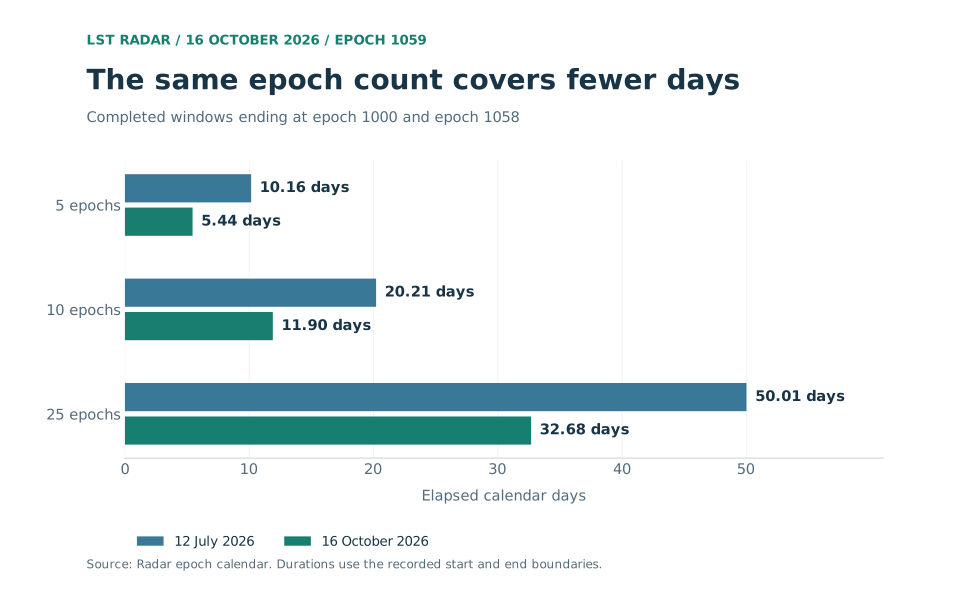
At the end of Solana epoch 1000, ten completed epochs covered 20.21 days. At the time of writing, 16 October 2026, epoch 1059, the latest ten completed epochs covered 11.90 days. The label stayed the same. The period it described became substantially shorter.
That is why LST Radar uses roughly fifty days for its headline APY. We want the observation window to keep a consistent meaning as the network changes, and as staking products develop different ways of delivering rewards.
The same number of epochs means less time
An epoch is counted in slots. Its duration in hours depends on how quickly those slots pass.
Our calendar records 49.17 hours for epoch 1000 and 25.96 hours for epoch 1058: the duration almost halved. We checked both against block timestamps at their boundaries.
That striking change spans Solana's staged reduction in target slot time from 400 milliseconds to 200 milliseconds, completed on 9 October 2026. Epochs still contain the same number of slots; those slots now pass faster. Our comparison captures a major protocol transition. A change of this size should not be treated as ordinary epoch-to-epoch variation or a trend that will keep repeating. Even with a stable slot-time target, actual epoch durations remain variable.
Longer windows show the consequence:
- Five epochs: 10.16 days ending with epoch 1000; 5.44 days ending with epoch 1058.
- Ten epochs: 20.21 days, then 11.90 days.
- Twenty-five epochs: 50.01 days, then 32.68 days.
Explore the epoch calendar to see how epoch durations and average slot times have changed over time.
A ten-epoch APY has become a shorter-term indicator without changing its name. A recent strong or quiet period occupies more of the history behind it.
Providers use different approaches. Published methods include ten-epoch rolling windows and day-based windows with additional averaging. The lookback period and any smoothing both matter when comparing displayed APYs.
Epoch-based APYs remain valid when annualised using actual elapsed time. The distinction is the question they answer: what happened over a particular number of epochs, or over a consistent amount of time? For a headline comparison, we prefer the second. Readers already know what fifty days means.
What different windows do to the same readings
We replayed compassSOL's recorded redemption values through five-epoch, ten-epoch and approximately fifty-day windows, using the same ending observation and the actual duration of each window.
At its epoch-1040 update, the five-epoch window covered 7.17 days and a 0.3883% increase in redemption value. Annualised, that was 21.82% APY. The roughly fifty-day window gave 8.69%.
Five updates later, at epoch 1045, that earlier burst of growth was outside the five-epoch window. Its APY was 6.40%, while the roughly fifty-day figure was 8.98%. These are dated calculations from our readings, reconstructed at the time of writing in epoch 1059.
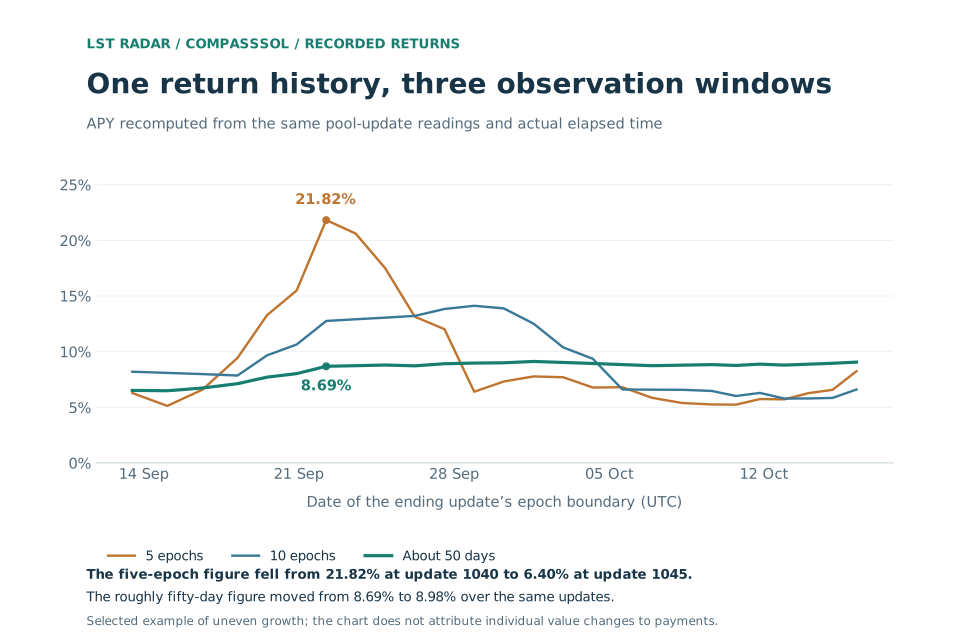
This illustrates window sensitivity; identifying the source of that growth would require a separate investigation. The effect also depends on the return history: at update 1040, the same calculation for JitoSOL gave 4.86% over five epochs and 4.94% over roughly fifty days. Steadier growth produced much closer figures.
Rewards have more than one schedule
An epoch is useful for understanding native staking rewards. A holder's broader return can also depend on validator fee sharing, incentives or contributions from outside the validator. An LST may receive additional value during an epoch, through frequent payments or occasional larger ones.
Staking products already separate these flows in different ways. Some incentive campaigns track rewards that participants can claim separately. Other products separate principal from rights to future rewards. These products need their own cash-flow accounting; their separate rewards are not automatically included in an LST's redemption-value APY.
For Radar's headline, the measurement is the change in SOL redeemable per LST. Additional value is captured when it is reflected between the chosen readings, whatever its source. A payment sent separately to a holder's wallet is outside that measurement.
A larger payment can lift the rate while it remains inside the window. Five or ten epochs later, it can disappear from a short-window APY. As epochs shorten, that happens sooner in calendar time. A day-based window keeps this period consistent.
Why we chose fifty days
APY already expresses growth on a yearly basis. We annualise the observed change in redemption value using the actual elapsed days, including compounding:
APY = (ending value / starting value) ^ (365.25 / elapsed days) − 1
The lookback period determines which experience is being expressed as an annual rate. Fifty days gives individual epochs and irregular payments less influence than a short window, while keeping recent changes relevant. We chose it as a practical compromise for understanding sustained recent performance. Other time horizons answer different questions.
The smoothing happens in the reported rate. It does not delay a payment reaching the pool or change what holders earned. A large payment can still influence the figure until it leaves the window, then cause a noticeable drop. A longer window can also take more time to reflect a lasting change in fees or rewards. History and shorter views help explain those movements. The headline describes recent experience; future returns can differ.
How Radar applies the window
Fifty days is our target. For pools with update-epoch data, the headline compares the first accepted reading after an epoch update with the corresponding update nearest fifty days earlier. We date those anchors to their epoch boundaries and report the actual duration. This avoids comparing different stages of an ordinary epoch reward update.
The result is approximately fifty days, with fewer days where available history is shorter. Additional payments after an epoch's first reading enter a later headline anchor. Ongoing fees are already reflected in redemption value. Entry and exit fees belong to the separate holding-period calculation.
As reward mechanisms become more varied, we think calendar-based windows will become the more useful default for headline yield comparisons. Epochs remain valuable for explaining how rewards arrive. Days keep the amount of history behind the number understandable and consistent.
You can download the epoch durations and APY comparisons behind these charts. See our APY methodology for how the headline is calculated.